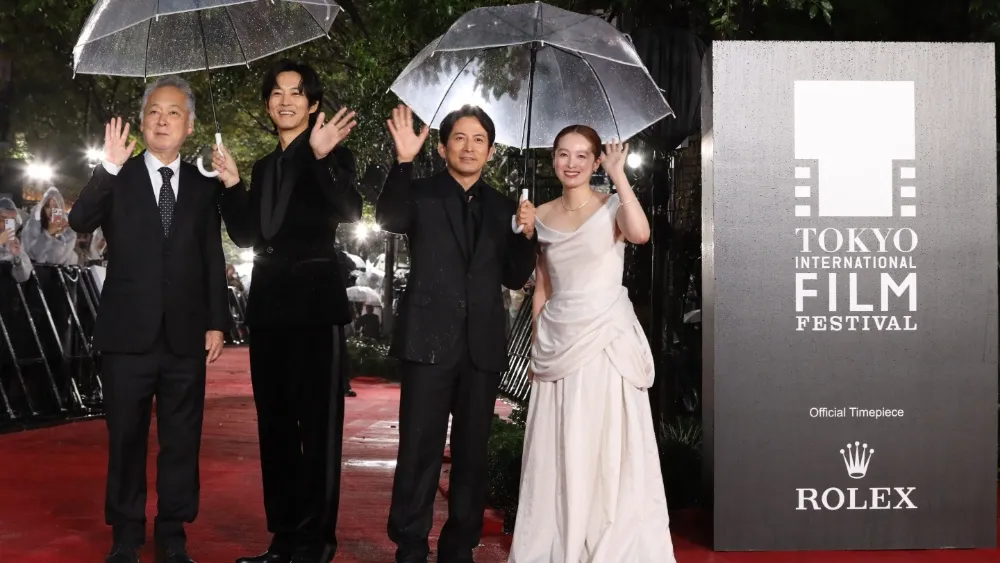
Zeze Takahisa’s “Sukiyaki,” the opening film of the 39th Tokyo International Film Festival, tells the story of how the title tune became a worldwide hit in 1963 and also became a beloved standard, with foreign-language versions recorded and topping the charts.
The film goes beyond the song and delves into the lives and careers of its producers: songwriter Ei Roksuke (Matsuzaka Tori), composer Nakamura Hachidai (Okada Junichi), and singer Sakamoto Kyu (Nakano Taiga). They became known in Japan as the “689 trio”, with the unusual nickname coming from the “number” characters in their names: Hachi (8), Roku (6) and Kyu (9). But their professional and personal relationships were not always harmonious, as the film shows after a series of highly dramatic scenes.
Interviewed at the headquarters of Toho, the film’s Japanese distributor, Zeze emphasized the importance of the film sixty years after “Sukiyaki,” known locally as “Ue o Muite Aruko” (I Will Walk with My Head High), first hit the charts. “At that time, the country was recovering from war and all kinds of influences were pouring in from abroad. These influences created an energy that stimulated the popular culture here. Japan now receives less influence from abroad. The culture used to be wide open, now it has become even narrower.”
But young Japanese are now discovering the energy from the Showa Era (1926-1989), the reign of Emperor Showa when Japanese pop culture was at its fertile peak. Along with nostalgic Boomers, they can also be found among viewers of “Godzilla Minus One,” the 2023 smash hit Godzilla series set in the early post-war era. Director Yamazaki Takashi’s sequel “Godzilla Minus Zero” is also at TIFF as the festival’s Central screening, Zeze jokingly said, “It’s kind of a Showa explosion.”
Although Nakano Taiga conveys Sakamoto’s exuberant stage persona with uncanny precision, he says the main criterion in choosing “Sukiyaki” was not physical resemblance to the main characters. “It was more about the emotion the actors conveyed,” Zeze explains. “But Taiga comes from a showbiz family with roots in the film era, so she had a natural affinity for this role. Also, when Sakamoto sings in the movie, you hear Taiga’s voice; she has incredible talent as a vocalist.”
But the film’s drama focuses more on Nakamura and Ei, who joined forces to compose a string of hits in the 1960s, but quarreled and separated as Nakamura descended into alcoholism. “After ‘Sukiyaki’ became a hit, Nakamura went through a difficult time, and we show that,” says Zeze. “The film wouldn’t be interesting if it was just a success story; it has to have both ups and downs.”
None of this drama had much to do with “Sukiyaki” becoming a hit overseas, but the film also explores the sources of its creation, from Nakamura’s mastery of the jazz piano he performed in New York clubs to Sakamoto’s roots in early rock (he was a huge Elvis fan) and Ei’s composition of the poignant Japanese lyrics.
“Of course, people abroad did not understand the lyrics, but the energy of the song was reflected in them too,” says Zeze. “The lyrics reflect what was happening in Japan at the time.” Lyricist Ei Rokusuke was inspired by the demonstrations against the Japan-US Security Treaty in 1960. “The demonstrators called for peace, but they could not stop the ratification of the agreement. He asked them to ‘walk with their heads held high’ despite their defeat,” says Zeze, and adds: “So the song has depth; it is not just a cheerful pop tune.”