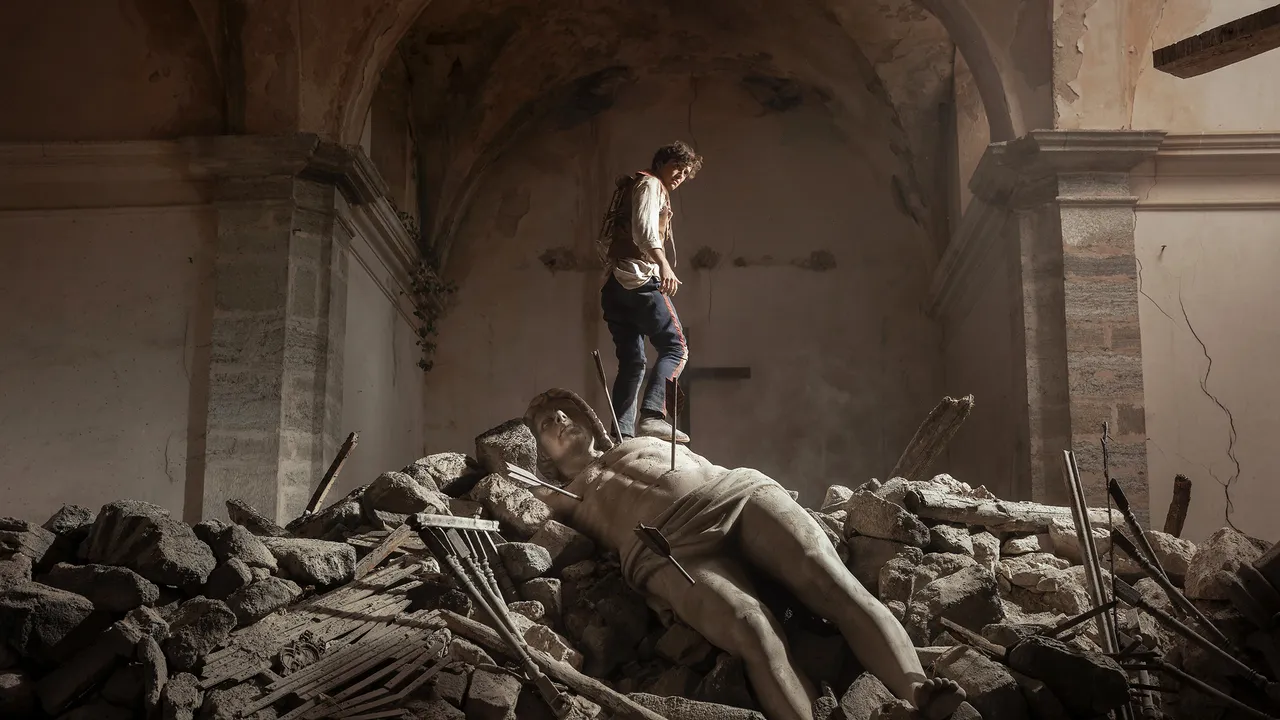
Sebastián and Rafael are not the only notable characters. Ambrossi and Calvo both go by the moniker Los Javis, so it shouldn’t surprise us if they approach their narratives with a similar spirit of multitasking compression. The film consists of three stories set in three different time periods, unfolding them simultaneously in a frenzy of hyper-controlled intercutting. Sebastián’s story is adapted from the play “La Piedra Oscura” by Alberto Conejero (considered a co-author of Ambrossi and Calvo) and is the most important of the three, with the other two stories wrapped tightly around it like taut vines. Shortly after meeting Sebastián, we set off for Granada in 1932; Here, Carlos (Milo Quifes), a shy, elegantly dressed young man, is applying for membership at an exclusive casino. But the casino committee rejects his offer, as we later learn, because of cruel but true rumors of his homosexuality: “Bola negra, bola negra, bola negra,” sings the refrain, as the damned black balls roll down the spear, one after another. Carlos’ wealthy, image-conscious father orders him to return to the casino the next day and disprove the suspicions. His mother, who has a quieter supportive spirit, encourages him to move to Madrid, where he can live more freely.
We get a refreshing taste of this freedom in the third strip: It’s 2017, and Alberto (Carlos González), a historian living in Madrid, only has to look at Grindr to satisfy an urge (“Have sex now,” he writes, before saying a word). It’s the opposite of Carlos, who has to follow a potential trade through the streets at night, and Sebastián, whose throat goes dry when he sees Rafael’s bare chest. You could argue that Ambrossi and Calvo were old-school romantics at heart, alive to the cynical thrill of prohibition and thus skeptical of the modern age and its all-too-convenient spoils. If his dissertation (featuring the odd dissident musician from the 1920s) is any indication, Alberto himself seems nostalgic for the tensions of a brutal past era.
A more complex research project awaits him. Alberto learns that his grandfather, from whom his mother Teresa (Lola Dueñas) was violently estranged and to whom he had never introduced his son, had recently died and left him an interesting legacy, a mystery that needs to be solved. The answers the viewer is likely to guess will bring the 1932 and 1937 episodes into a unifying focus, and while González makes Alberto an intriguing enough detective, he cannot transcend the passive, puzzle-solving function assigned to the character. “Isn’t it funny how the only story you don’t care about is your own?”, in the words of Alberto’s anxious boyfriend (Julio Torres), who perhaps reveal more of the film’s shortcomings than he realizes.
Before “La Bola Negra” won Best Director at this year’s Cannes Film Festival (an honor it hilariously shared with Paweł Pawlikowski’s starkly minimalist “Fatherland”), Ambrossi and Calvo were known for many things. They were a power couple in the Spanish entertainment world for more than a decade before ending their relationship late last year. Past collaborations include several TV series, including the popular “Veneno,” a portrait of transgender sex worker and entertainer Cristina Ortiz Rodríguez, and the 2017 feature “La Llamada,” based on her own stage musicals. They’re also card-carrying moviegoers, as they took the trouble to show off in a recent interview: “La Bola Negra,” they said, carries the artistic DNA of such wartime youth classics as Andrei Tarkovsky’s “Ivan’s Childhood” (1963) and Elem Klimov’s “Come and See” (1987), as well as Claire Denis’s soldiers-glorified masterpiece of eroticism, “Beau.” Travail” (2000). My mind wandered to other great films, including Hou Hsiao-hsien’s “Three Times” (2006), a century-spanning trilogy that both preserves and subverts the boundaries of linear time, and Terence Davies’ “Blessing” (2022), a heartbreaking biographical portrait of a war veteran and poet who views his own homosexual desires with deep ambivalence.
But the peculiar artistic touchstone I hear most often cited in connection with “La Bola Negra” is Stephen Daldry’s “The Hours” (2002); If anything, it is a comparison that is unflattering to either side. In both films, everything comes in threes, incessant intersections are given ostentatious metaphysical weight, and time itself is manipulated, distorted, and rearranged to the point of meaninglessness. The complexity of humankind’s age-long longing is not explored so much as resolved in the manner of a mathematical proof. So what exactly is being proven here? The universality of pain? The magic of editing? Perhaps this is because the most self-consciously expansive films are often the most reductive, the most diagrammatic, and, incidentally, the most likely to retreat into the shadow of a great artist. “The Hours” framed itself as a morbidly repressed valentine to Virginia Woolf, and “La Bola Negra” hangs itself on the mantle of another queer literary giant, Federico García Lorca, with irrepressible enthusiasm. Although Lorca is not given his own narrative, his life and legacy—the passion of his left-wing activism, the subversion of his art, and the open secret of his homosexuality—form the fabric that ties together all three of the film’s stories.