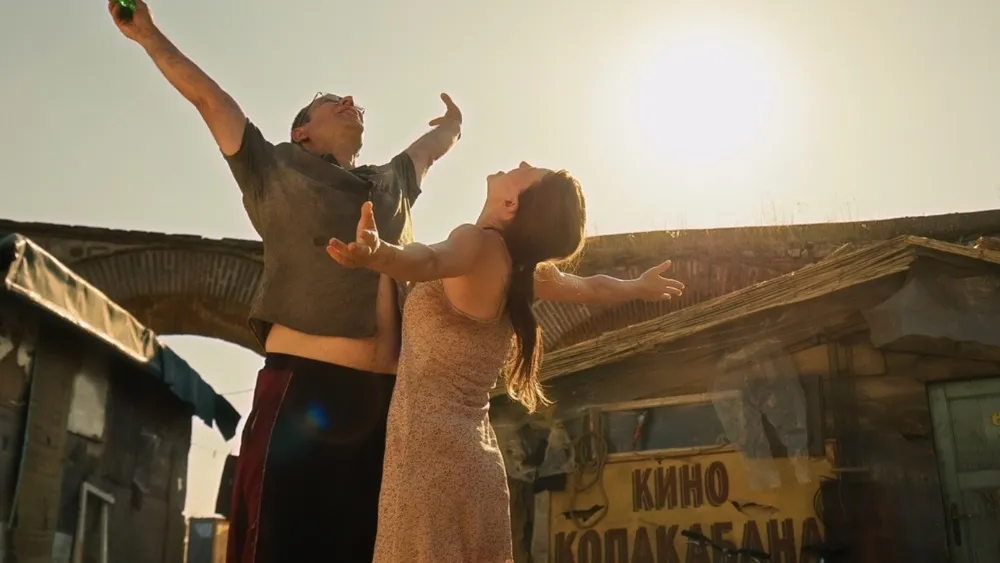
Milcho Manchevski’s “Brother Brother Manhole Cover,” a humorous allegory about two brothers robbing scrap metal from the streets of Skopje, won the Tokyo Grand Prix at the 39th Tokyo International Film Festival on Wednesday.
A steady drizzle at Hulic Hall on the closing night failed to dampen the spirits of the entire hall, a milder send-off than the downpour that greeted the festival’s October 26 opening.
Jury president Rolf de Heer said the jury selected the film “because of the humanity and compassion shown to its characters” and because it was “a complex, coherent film that manages to be both touching and entertaining”. The prize is worth JPY 3 million ($19,000). Viktor and Malina earn their living by stealing manhole covers and copper busts. When a stolen bronze bust of a national hero falls at Viktor’s feet, the duo plummet to the lowest depths of North Macedonia’s capital. The film, which is a co-production of North Macedonia, Bulgaria, Serbia, Albania, Italy and England, is Manchevski’s first fictional feature film since Kaymak.
Since Manchevski had left Tokyo, producer Jane Kortoshev and the film’s leading actors Sara Klimoska and Filip Trajković accepted the award. Tokyo Deputy Governor Yamashita Satoshi presented the Tokyo Governor’s Award in place of Governor Koike Yuriko, who was unable to attend.
Kortoshev said, “We came to Tokyo with a manhole cover, and we are returning to Macedonia with a nice reward.” “I’d say that’s a pretty good deal, right?”
Manchevski appeared with a video message.
“This award is a small testament to an interesting film that almost didn’t happen,” Manchevski said. “It’s a movie about unusual families, the haves and the have-nots. It’s a movie about people, not messages.”
Rolf de Heer’s judges included producers Alex Lo and Oh Jungwan, actor Watanabe Makiko and colorist Yov Moor. In his overall assessment, Heer said that the 15 competition titles had little in common, making it difficult to evaluate them against each other.
“He was like a programming director [Ichiyama] Shozo was playing tricks on us when choosing films or testing us,” said de Heer.
The Special Jury Prize of JPY 500,000 ($3,200) was awarded to Sun Xun’s animated film “Magic Atlas,” which the Chinese-born artist in Singapore spent nearly a decade creating. In this film, an orphan inherits a magician’s book and uses it to recover memories buried by an authoritarian empire. The animation progresses from ink wash painting to Medieval European woodcut. Juror Oh Jungwan noted the film’s “extraordinary craftsmanship”. Speaking through a translator, Sun said it was a big surprise to be selected for the competition and an even bigger surprise to win.
Lisandro Alonso won the best director award for “Double Freedom,” which the festival presented as a sequel to his first film, “La Libertad,” in 2001. A lonely lumberjack’s life in the forest is turned upside down when he is forced to take in his sister’s psychiatric facility after it closes. Juror Alex Lo praised the film’s “minimalist yet effective cinematic language” that “sensitively captures the weight and passage of time.” Alonso was unable to travel. He said in a video message that he hopes to come to Tokyo “with another movie in the future.” The directing, acting and artistic contribution awards are worth JPY 300,000 ($1,900) each.
Japan’s only win in the main competition came in the acting category. Narita Ryo was named best actor for Mishima Yukiko’s “Two Cigarettes, Three Nights”. She stars as her longtime friend, played by Matsuoka Mayu, who reconnects with a Kyoto illustrator who lingered in three cities for three nights. Narita was not at the ceremony and Mishima accepted the offer on his behalf.
“There was one day when we needed snow badly and it just wasn’t coming,” Mishima said. “I was looking at the sky and saying, ‘I wish it would snow,’ and Narita, who was standing next to me, was saying to the sky, ‘Let it snow!’ he shouted. And it snowed.”
Best actress went to Hu Ling for Wang Jiangyong’s feature debut, “The Night That Binds Us.” She plays a dejected Shanghai dormitory director who falls in love with a younger student whose parents have been arrested on suspicion of fraud. A visibly emotional Hu thanked his alma mater, Beijing Film Academy.
Jelena Maksimović’s first feature film “Until the Day Ends” received the award for best artistic contribution. In the film, a student activist and a young government supporter hit the road together during Serbia’s 2024 protests. Maksimović dedicated the award to the students and citizens of Serbia who spent the last two years fighting for freedom.
Festival director Hisamatsu Takeo presented the audience award, which does not include a cash prize, to Teodora Ana Mihai’s work “Heysel 85”. The film re-enacts the 1985 Brussels stadium disaster, where fan violence killed 39 people ahead of the European Cup final.
“There’s always some fear that this won’t be received well,” Mihai said. “So this is very special.”
In the Future of Asia section, Tarık Daoud’s Swiss-Turkish film “Şerife Rabbit” won best film and JPY 1 million ($6,300). In the film, a newly widowed woman in her 70s sets out to please herself, and her children oppose her new lifestyle and friendships. Special mention was given to Ariani Darmawan’s Indonesian film “Jani Be Good”. Set four days before Christmas, the film tells the story of a girl who conflicts with her single mother after her older sister leaves home.
Nippon Cinema Now’s best picture went to Tanaka Miki’s debut “Silver Express,” which earned JPY500,000 ($3,200). In the film, a young woman who has never been attracted to anyone before forms a romantic bond with a man who shares the same characteristics as her. Matsumura Shingo’s “Between Us” took the episode’s Special Jury Prize and 300,000 JPY ($1,900). The film follows two former child actors who meet again at their high school drama club six years after a family camping trip separates them.
Isabelle Stever’s “I Rarely Wake Up Dreaming” won the TIFF Ethical Film Award and 200,000 JPY ($1,300). The award was evaluated by a jury chaired by actor Isomura Hayato. Based on a true story, the film follows a gay Ukrainian couple who becomes stranded during the Russian occupation just after one of their partners legally changes his gender marker because military rules prevent him from leaving.
At the Asian Students Film Conference, which featured short films prepared by students at film schools in Asia, Nguyen Vu Hien Chi’s “Running Wild in the Sun” won the best film award and 300,000 JPY ($1,900). Nah Yi-chen’s “Everything’s Peachy” and Kim Nam-hyeon’s “All of Her” shared the Special Jury Prize, receiving 100,000 JPY ($630) each.
The Kurosawa Akira Prize, worth JPY 1 million ($6,300) to each recipient, was awarded to O Mipo and Mohammad Rasoulof. Bill Kramer, CEO of the Academy of Motion Picture Arts and Sciences, received the Special Award for Global Cinematic Leadership.
Following the awards, the festival screened the closing film of Yeon Sang-ho’s Korean zombie thriller “Colony,” set in a high-rise building that was shuttered after a bioterror attack. Yeon introduced the film with star Koo Kyo-hwan, producer Yang Yoomin, and the voices of Nao and Kaji Yuki in the Japanese dub of the film.
“I think of theater as a form of entertainment where you can safely immerse yourself in lives and situations you’ve never experienced before,” Yeon said. “In ‘Colony,’ you go through the kind of struggle for survival that would be terrifying in real life. I hope you enjoy it in the theater.”
Kaji said the infected person’s movements were not created with CGI but were performed by contemporary dancers. “Colony” opens in Japan on January 1.
In his closing remarks, Hisamatsu said he was looking forward to next year’s 40th edition, describing it as a milestone that will set the tone for the next decade of the festival.
“Not every movie is bright and cheerful,” Hisamatsu said. “But a festival should be a place where you can enjoy, talk about and celebrate films of all kinds.”
The stage time provided by festival sponsor Rolex may be a first for the festival. This certainly proved that the organizers knew how to execute a meticulously timed ceremony that ended one minute after the scheduled closing time. The second-by-second choreography, in which two female assistants direct the judges and winners to the millimeter where to stand, increased the precision of the clockwork.
The tuxedos were visible to a handful of men, including programming director Ichiyama and festival director Hisamatsu. This was in contrast to past years, when men’s formal attire was more common among TIFF VIPs.
The festival took place from October 26 to November. 4.
Full list of winners:
Tokyo Grand Prix / Tokyo Governor’s Award
“Brother Brother Manhole Cover,” is. Milcho Manchevski
Special Jury Prize
“The Magic Atlas”, dir. Sun Xun
Best Director
Lisandro Alonso, “Double Freedom”
Best Actress
Hu Ling, “The Night That Binds Us”
Best Actor
Narita Ryo, “Two Cigarettes, Three Nights”
Best Artistic Contribution
“Till the Day Ends”, dir. Jelena Maksimović
Audience Award
“Heysel 85”, dir. Teodora Ana Mihai
Asia Future’s Best Movie
“Sherife Rabbit,” he says. Tariq Davud
Special Mention for the Future of Asia
“Jani Be Good”, director. Ariani Darmawan
Nippon Cinema Now Best Film
“Silver Express”, dir. Tanaka Miki
Nippon Cinema Now Special Jury Award
“Among Us”, dir. Matsumura Shingo
Asian Students’ Film Conference Best Film
“Running Wild in the Sun”, dir. Nguyen Vu Hien Chi
Asian Students’ Film Conference Special Jury Prize
“Everything is Peach,” is. Nah Yi-chen
“All His”, dir. Kim Nam-hyeon
Kurosawa Akira Award
mipo
Muhammad Rasulof
TIFF Ethical Film Award
“I Rarely Wake Up Dreaming,” is. Isabelle Stever
Special Award for Global Cinema Leadership
Bill Kramer, CEO, Academy of Motion Picture Arts and Sciences