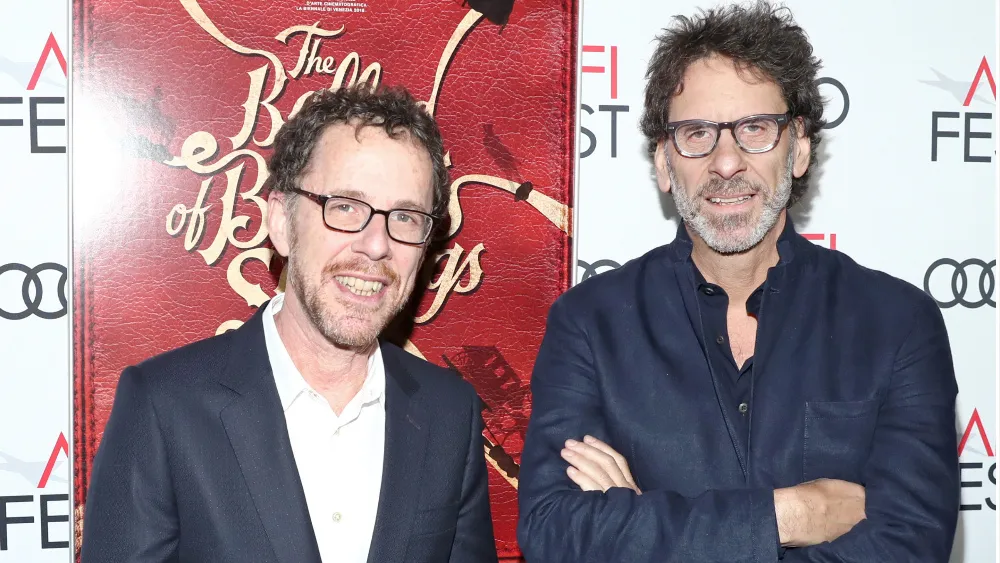
The Coen brothers may be returning to their hometown of Minneapolis for a reunion eight years after their last collaborative film, “The Ballad of Buster Scruggs.”
At the Lyon Lumière Film Festival, where they received a career tribute award, Joel and Ethan Coen announced that they have many projects in preparation in Minneapolis, where they previously shot “Fargo” in 1996 and “A Serious Man” in 2009.
“We didn’t discuss in terms of plot, narrative or genre of film. But we did discuss returning because there were some crew people we were missing,” said Ethan, sitting with Joel, Lumiere festival chief Thierry Fremaux (who is also president of Cannes) and film journalist Didier Allouche.
“Yes, we’ve got a few more stories that we’re thinking of taking place in Minneapolis, where we’re from. So we’ll see if they germinate to where we’re going, you know, that’s what we’re going to do next, in fact, we’re definitely going to do it,” Joel Coen said.
Joel was responding to a challenge from his wife of 42 years, Oscar-winning actor Frances McDormand, who playfully invited them onstage at the Lumiere ceremony to complete the unofficial trilogy that began with “Fargo” and “A Serious Man.” Joel said, “I think Fran wants to see this. Let’s see if we can make room for her.” he joked.
Since Netflix’s “The Ballad of Buster Scruggs,” Joel went on to direct “The Tragedy of Macbeth,” starring McDormand and Denzel Washington. Ethan, on the other hand, wrote “Drive-Away Dolls” and “Honey Don’t!” with his wife and long-time collaborator Tricia Cooke. He produced the films.
But the brothers said they continue to write together and have several scripts that have not yet been produced. “We wrote a lot of scripts that we never did,” Ethan said. Joel later joked that “we couldn’t find one of these on the computer.”
“One of the Minneapolis stories we talked about had a lead segment for an actor who has since died. So we’re not sure if that would work. That’s a consequence of aging,” Ethan said.
While they were each working on a separate film, they also wrote a new script together, but it seems outdated now. “It deals with issues in the culture that we’ve sort of moved away from, or that the culture has moved away from. It’s more like a period piece now. Should we do this or shouldn’t we?” he said. “Ethan suggested they could introduce the movie with a title card that said, ‘Sometime during the Obama administration.’ It almost happened, but not anymore.”
Still, the brothers don’t want to get overly political, even though their films are mostly satire. “Things like the political situation in the United States are kind of the backdrop against which you tell stories. But the idea of embodying that, especially in terms of Trump, is probably not in our wheelhouse in terms of how we think about a story,” Joel said.
“Right now we don’t feel like any of our movies are commenting on America or anything other than the story itself. Viewers are entitled to treat our movies however they want. It might be entirely appropriate for a viewer to make those comparisons, but we don’t literally think of it that way,” Ethan said.
The Coens also weighed in on the changing film business, including the role of streaming platforms supporting some of their latest projects. Netflix produced and streamed “The Ballad of Buster Scruggs,” while Joel’s “The Tragedy of Macbeth” was released theatrically by A24 before streaming on Apple TV+.
When asked about streaming’s impact on cinema, the brothers said they had mixed feelings, noting that their own careers benefited from the rise of home videos in the 1980s, when studios were more willing to finance independent films because they were additional ways to make money.
“Oddly enough, we owe our careers to the fact that there are other formats for distribution, and those are home video formats,” Joel said, adding that it would be “disingenuous” to directly oppose new distribution platforms.
But Joel also defended his theater experience, reiterating his comments at a masterclass he attended with Ethan in Lyon on Friday. The worst thing that can happen to you is someone saying, ‘I loved your movie.’ “I saw this on a plane.” It’s very discouraging,” Joel said. “This festival is all about sitting in a big room with a bunch of people watching in the dark. There’s no alternative to that. I think every filmmaker feels that way.”
He argued that broadcasters are also beginning to re-understand the importance of theatrical broadcasts. “I actually think there’s come a point where streaming services are re-realizing the value of theatrical distribution, and I expect that will continue and that everyone will see that as a clear advantage,” Joel said.
Asked about AI, Joel dismissed the idea that AI could take over screenwriting as “nonsense” but criticized the “computer-generated imagery” that AI helps create, even as it helps filmmakers create images and worlds that would otherwise be impossible.
“In a way, everything is becoming a cartoon. Every movie is an animated movie, or is increasingly looking like one, especially because of things like artificial intelligence and computer-generated effects,” he said.
Joel cited the 1990 movie “Miller’s Crossing,” recalling how the opening shot of a hat flying through the trees was created using thin wires manipulated by crew members outside the frame.
“There’s no one in the world that does it that way anymore. It would be animation, and I’m pretty sure it wouldn’t be that pretty. You lose things with certain types of visual effects, and you definitely lose those things with AI,” he continued.
The brothers were also joined by Paramount-Warner Bros. Questions were also asked about the impact of the merger on the filmmakers.
“The honest answer is, I don’t really know how any of this is going to be resolved. And I don’t know enough about the politics of who owns what,” Joel said, laughing nervously when pressed about the merger. “Frankly, I know it’s not good to have all these companies merged into one or two companies or three companies. Because competition is what drives the market, but it also creates opportunities for different types of films.” Regarding Paramount’s leadership in particular, he said: “I don’t know about David Ellison.”