Japan’s production committee system, in which a group of companies jointly finance a film and share its rights, has helped spread risk throughout the industry. But it could also limit the budget to what the industry itself can raise, making it harder for overseas investors to participate and slowing down the decisions each rights holder must agree to.
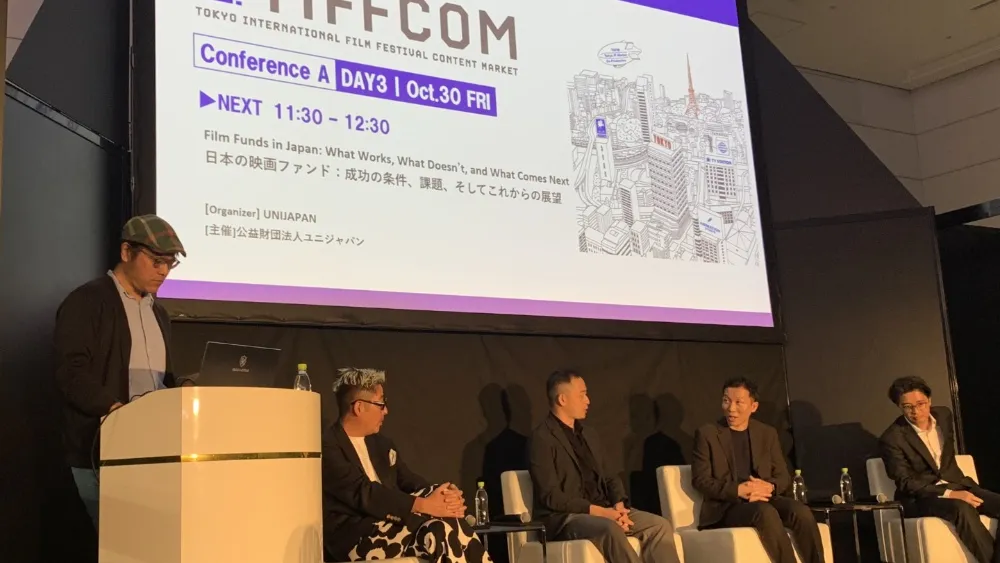
At a panel at TIFFCOM, the Tokyo International Film Festival’s content marketplace, speakers examined whether film funds could ease these limits while adapting to the Japanese market.
“Film Funding in Japan: What’s Good, What’s Useless, and What’s Next” features Kii Muneyuki, CEO and producer of K2 Pictures, who works with filmmakers such as Kore-eda Hirokazu, Miike Takashi, and Nishikawa Miwa; Ibe Tomonobu, CEO of Questry, a Tokyo-based startup that uses digital securities to finance anime and other Japanese content; Nakagawa Keita, general manager of MUFG Bank; and Motoyanagi Yusuke, partner at the law firm Nishimura & Asahi.
Kii presented K2P Film Fund I as an example of the new structure. The fund closed in February at nearly JPY5 billion ($32 million) and aims to support about 50 films over seven years. This is a blind pool, meaning investors put money in before movies are selected. Its investors include MUFG, the Development Bank of Japan and other financial institutions and companies, and project approvals are overseen by a green light committee. Kii said five films will be released in theaters in 2026.
Kii said the key issue for film funds is how to return revenues to creators, including revenues from streaming and other windows, after the film’s release. He also said it was difficult to rely on box offices overseas and that Japanese companies needed to build businesses beyond distribution.
The panel compared the financing structures in the USA and South Korea. In the US, manufacturers combine pre-sales with completion guarantees to help secure bank loans. Completion assurance covers the delivery of a film on budget and on time, rather than its commercial performance. South Korea relies on public-private support along with government-backed guarantees that help projects receive bank financing.
Nakagawa presented a Japan-specific feasibility study commissioned by the Ministry of Economy, Trade and Industry. MUFG was selected to carry this out on March 31st. The study, which will run until February 2027, will use real-world data to develop valuation and completion assurance models and test the entire process, from application and review to contract drafting. The study evaluates feasibility and does not guarantee that financing or completion guarantees will be available.
The discussion ended with four priorities: regulation, capital, creators and cross-border trade. These include clarifying which regulations should be expanded and when, combining debt with subsidies and completion guarantees, and converting creative returns into fund structures. Speakers also noted language and tax barriers to cross-border investment, including “establishment of business” rules that could make international investors liable for Japanese tax.