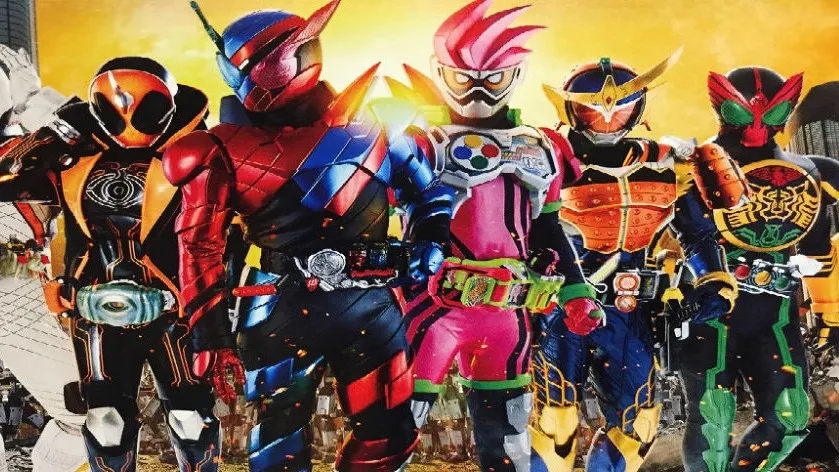
At the Taiwan Creative Content Festival (TCCF) in Taipei, president and CEO Yoshimura Fumio said Toei, the Japanese studio giant behind the Super Sentai series that became “Kamen Rider” and “Power Rangers,” has set guidelines for generative AI and has begun using AI in film and video production.
A dedicated team at the company is testing how AI can be used in actual content production, and Toei is building an AI system to help less experienced producers estimate budgets.
“We have established rules for the use of generative artificial intelligence, and starting this year we have started using artificial intelligence in our film and video productions,” said Yoshimura. “We’re already working on things like creating backgrounds with AI.”
Toei’s back-office departments also use AI for routine tasks, data processing and internal queries, and the company is considering applying it to creative control of intellectual property products. Yoshimura pointed to “Dreams of Violets,” a live-action film made entirely with generative artificial intelligence that was selected for the Tribeca Festival in June. The 75-minute film was reportedly made by the two creators for approximately $2,000.
“I believe AI is not something that eliminates jobs, but a tool that expands expression and job opportunities,” he said.
Toei also put out a timeline for the transition to games. Launched this year to celebrate the company’s 75th anniversary, Toei Games company will release “Hino” in early 2027, while “Killa” and “Debug Nephemee” will be released from spring 2027. All three are original games from outside creators rather than adaptations of the Toei IP, and will be released on Steam before hitting Nintendo Switch, PlayStation, and Xbox.
“As a new vein of intellectual property creation, we aim to engage the talents of game creators in the long term and make games the starting point for stories, replacing novels and comics,” said Yoshimura.
The opening speech also discussed how Toei is taking “Kamen Rider,” which turns 55 this year, beyond Japanese TV. Yoshimura cited the franchise as a prime example of what the company calls the “evergreening” of intellectual property. The first series premiered in 1971 and Showa-era shows ran until 1988, establishing the core fan base. The Heisei-era series, which began in 2000, passed the franchise from parents to children, while events, merchandise, manga, anime, and stage shows have since carried it into the third generation.
The current series “Kamen Rider Zeztz” was released almost simultaneously worldwide, including Taiwan, the rest of Asia and North America, which Yoshimura described as a big step for the group. Toei is also pushing into India. “Kamen Rider” was unveiled at an intellectual property event in Japan in 2025, and the strong response led to a deal with a local Disney-affiliated company.
“Given the population size and the increasing incomes of the growing middle class, I think India can be called an extremely promising market in the medium and long term,” said Yoshimura. “We think it will take time for this to take root as a business, but it is important now to build connections and steadily grow our partnerships and fan base.”
In April, Toei launched The Kamen Rider Animated, an animation franchise. For its first project, the studio is teaming up with Aniplex, the company behind “Demon Slayer,” and Shirogumi, which is working on Yamazaki Takashi’s “Godzilla Minus One” on a new “Kamen Rider” feature that has the scale and style of action only animation can provide. Live-action company The Kamen Rider Premium will produce full-scale hero action movies for a wider audience, including international audiences and those who don’t follow the TV shows.
Within the scope of Toei New Wave 2033 medium and long-term plan, the company aims to increase the share of its sales from abroad from 30% to 50%, currently focusing on Asia. Yoshimura estimates that the global entertainment and media market is growing at an average of 3.4% per year. He added that streaming now allows K-pop, Japanese anime, Indian movies and Chinese microdramas to travel the world unchanged.
“As content grounded in local culture and histories like ‘Shogun’ now transcends racial and national boundaries and fascinates people all over the world, I would say the main battleground for our business is overseas,” he said.
During the audience Q&A, Yoshimura said Toei had exported Japanese series unchanged before “Power Rangers” and they were struggling to win over Western audiences. This breakthrough came in the US only by preserving the characters and rebuilding the cast and drama.
“I believe this localization approach is indispensable for the characters to spread around the world,” he said. “We also understand that, unlike animation, live action work is not something that is easily accepted in every country.”
“Power Rangers” has now been airing in the United States for more than 30 years. In 2025, the original “Mighty Morphin Power Rangers” was re-released as “Mighty Morphin Power Rangers: Re-Ignition” with newly designed toys from Hasbro, a “Fortnite” collaboration and a Lego series in the works. Toei used a similar remake model in the Philippines. “Voltes V: Legacy,” a 2023 live-action remake of Toei’s 1977 anime “Super Electromagnetic Machine Voltes V,” peaked at 58% ratings here and was released in Japanese theaters the following year.
The company is also building stories from scratch in other markets. In February, it signed a strategic co-production partnership with Thai producer-distributor M Studio. Along with M Studio and Korea’s Showbox, he is adapting Ito Junji’s “Long Hair in the Attic” as a premium Thai film for Asian audiences. The film will be released in Thailand before heading to Japan and other regions.
In the co-production, Toei supported the Japan-Taiwan-US film “Dear Stranger” directed by director Mariko Tetsuya and starring Gwei Lun-mei and Nishijima Hidetoshi. It was shot entirely in New York and released last September. The project was selected for the Hong Kong Asian Film Financing Forum’s HAF and raised money overseas from the start with Taiwanese investors, including TAICCA’s TICP 2.0 program. Toei’s Kyoto studio is also supporting the Japanese shoot of “Iris,” an action thriller from a U.S. independent producer.
Toei is the only company in Japan to own and operate two studio spaces, one in Tokyo and the other in Kyoto. The Tokyo area is home to Japan’s only permanent 270-degree LED sound stage.
Toei also produces short-form content. “Everyday Host Club” is a short anime consisting of 24 episodes, each lasting approximately three minutes. Produced in a Kyoto studio for a client, “Meshimori Onna” is a vertical period drama consisting of 30 episodes lasting one to two minutes. Yoshimura suggested that vertical formats could one day even become the norm in cinemas.
Regarding Taiwan, he stated that in 2025, Japanese films will be the most released films in the market and will rank second after US films at the box office. Toei games released here include “Midnight Diner”, “Shin Kamen Rider”, “Howling Village” and “Oshi no Ko”. Local broadcaster YoYo TV is airing “Kamen Rider” and Toei is expanding its live character shows in Taiwan with a local partner. The studio also invested in Taiwanese horror film “The Rope Curse 4.” Yoshimura said he wants long-term tokusatsu partnerships with Taiwan and international co-productions.
“We are looking for partners with whom we can plan, create and present compelling stories to the world,” he said.
Yoshimura joined Toei in 1988. He worked in live events, licensing and digital distribution, including some of Japan’s first mobile content and subscription streaming services, and became president in 2023.