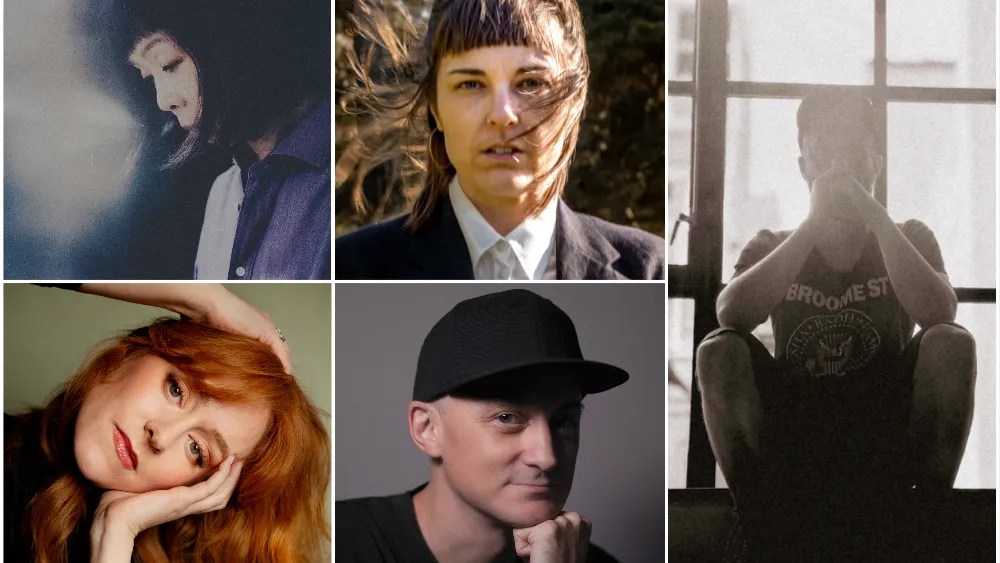
The World Soundtrack Awards’ Discovery of the Year has a knack for spotting emerging talent. Gustavo Santaolalla (“21 Grams”), Michael Giacchino (“The Incredibles”) and Nicholas Britell (“Moonlight”) won the award before reshaping modern film music, and recent winners Daniel Blumberg (“The Brutalist”) and Jerskin Fendrix (“Poor Things”) look poised to follow.
Meet this year’s five nominees.
Mari Fukuhara (“Little Amélie, or the Character of the Rain”)
Mari Fukuhara started playing the piano at the age of three, and then played in jazz and pop bands while studying classical music at the Toho Gakuen School of Music. He later established himself as a solo artist. “Looking back, I don’t think I followed a straight path to becoming a composer,” he says. “Or rather, all these different musical experiences naturally led me to cinema.”
In 2020, Fukuhara was approached by French producers about licensing one of his recordings for a new film. Within a few months, he signed on to compose original music for a pilot project that would eventually become “Little Amélie, or the Character of the Rain.”
“Being involved at such an early stage allowed the relationship between film and music to grow over time,” says Fukuhara. “It was very important to express a child’s perception, imagination, and what ‘reality’ means to a child. I felt that one of the important roles of music was to make Amélie’s experience of the world realistic.”
Looking ahead, Fukuhara hopes to return to live performance as he pursues projects for “a film where I can explore a different kind of musical territory – driven by images, atmosphere and feeling rather than a clear narrative.”

Paris Hurley (“Chronology of Water”)
Paris Hurley, who received classical violin training from an early age, received great acclaim with her autobiographical live project Object as Subject before turning to cinema. “I’ve been told over and over that my music is too cinematic,” he says. “There’s a forward momentum and a deep emotional core that takes the listener somewhere. What people responded to was the sense of leading someone on an emotional journey.”
After working with Clint Mansell on “Love Lies Bleeding,” Hurley tackled Kristen Stewart’s “The Chronology of Water” on her own and continued the project after examining the source memoir. “I read it one weekend and my whole body went up in flames,” he recalls. “I immediately realized that I had to score the film.”
This visceral response reflects a lifelong fascination with music as a physical experience. “The sound is riveting,” he says. “I always try to immerse people in the sound, whether it’s hitting your face, inside your ear, or around you. Film is a fun way to explore that because it can be so spectacular. Music changes you physically, whether you’re doing it or listening to it.”
Hannah Peel (“Midwinter Holiday”)
While she was fishing for film and TV, Hannah Peel also began doing session work on violin, trombone and piano for various artists. When the Royal College of Music told him he wasn’t classical enough for a master’s degree in film music, he went his own way and released records built around a music box with hand-punched paper strips. The unusual instrument eventually caught the attention of musical consultants on projects such as “Anna Karenina” and “Dancing With the Stars.”
Peel’s work on the 2019 documentary “Game of Thrones: The Last Watch” earned him an Emmy nomination and management gig, and he’s been steadily working ever since to develop a style balanced between acoustic and electronic textures. “It’s much more common now for people to create their own sounds, and the blur between sound design and music is where I like to sit,” he says.
He is currently scoring Netflix’s “Assassin’s Creed” series, developing a sound that blends old and new while drawing from games. “Everything about it was great,” he says. “I was able to explore instruments that I couldn’t find in the sample libraries, so I could create my own sound worlds. This excites me because I have something that’s unlike anything else, and the production has been open and supportive.”
Kangding Ray (“To cry”)
Trained as an architect and born David Letellier, Kangding Ray made a name for himself in Berlin’s experimental music scene by quietly releasing music on German record label Raster-Noton, known for artists such as Ryoji Ikeda, Alva Noto and Ryuichi Sakamoto. Experimental and ambient work gradually gave way to dance and, almost naturally, to film. His debut music for 2022’s “Kiss My Scars” caught the attention of German awards voters. Shortly after, director Oliver Laxe came and invited him to compose “Sirāt”.
The process started unusually early. Ray began work two years before filming, and Laxe spent five days in his studio in Berlin. By the time cameras started rolling, about 80% of the film had been written from the script. The result is approximately 62 minutes of music, focusing on important scenes. “It’s either completely present or not present at all,” he says. He also pushed for silence, convinced that the music hits harder when it comes.
Sam Slater (“2000 Meters to Andriivka”)
Sam Slater fell into film scoring by accident. The Berlin-based composer, who describes himself as a “studio nerd”, got his start as a sound designer and creative engineer for Jóhann Jóhannsson, Dustin O’Halloran and Hildur Guðnadóttir, whom he later married (“which is lovely”).
“This sparked my love not only for film work, but also for its experimental essence, which has always been where my curiosity lies,” he says.
His work now spans multiple formats, from the Emmy-winning documentary “2000 Meters to Andriivka,” directed by Pulitzer Prize-winning journalist Mstyslav Chernov, to the PlayStation 5 game “Saros,” which NME called “the stuff of nightmares.”
This range suits her. “When you move into non-diegetic audio, which is an abstract expression of a story or emotion, you enter a wonderful world,” he says. “Our generation wants to expand the palette as much as possible. The fact that we’re debating whether something is sound design or music means we’re reaching the weird and wonderful frontiers of what music is in those contexts, and I find that exciting.”