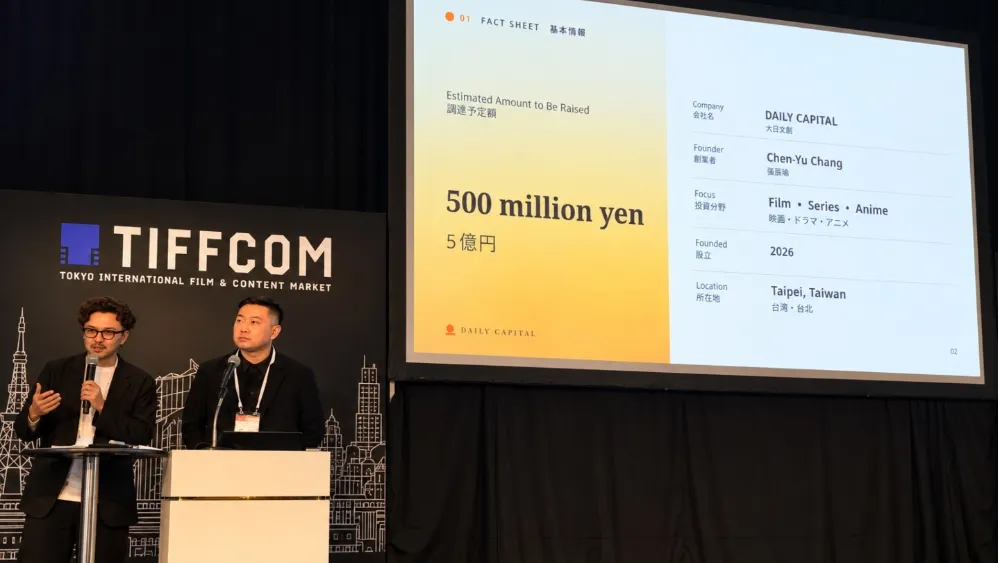
Daily Capital, a new fund focused on Taiwan-Japan film and television co-productions, launched at the “Taiwan Originals: Project Showcase” event on the opening day of TIFFCOM in the Tokyo International Film Festival market.
The fund aims to raise NT$100 million (about $3.1 million) in the first two years and invest in at least five projects in film, television and animation. Founder Chang Chen-yu said fundraising has reached 70 percent of the target and he expects the fund to be operational by the end of the year. Diversity.
Chang said at the launch that the name “Daily” reflects the idea that meaningful progress is achieved through daily efforts.
In Japan, Daily Capital has named K2 Pictures and Remow as joint development partners. Founded by producer Kii Muneyuki, K2 Pictures brings together Japanese filmmakers such as Iwai Shunji, Miike Takashi, Nishikawa Miwa and Kore-eda Hirokazu. Remow is backed by Japanese entertainment and media companies such as Shueisha, Toei, Amuse, Shochiku, TBS Holdings and Fuji Media Holdings, which have access to established IP libraries and distribution networks.
“Investment amounts will vary depending on the scale and needs of each project, whether it is a film, TV series or animation. We expect to come in during development or pre-production, contribute to script discussions and help assemble the core creative team. We also aim to keep the capital recovery period within three years,” Chang said.
The fund plans to match Japan’s intellectual property and production know-how with Taiwan’s flexible financing and co-production experience. It will also leverage local production incentives and distribution networks to reach audiences beyond Japanese and Mandarin-speaking markets.
The first investment announced was the TV series “If Love Blooms, It Ends”. Set in Chiayi and Alishan in the 1930s, the 10-episode historical love and business drama tells the story of a Japanese geisha who plans a cross-border marriage to save her mother and then embarks on a forbidden romance with a Taiwanese lumber magnate. The story unfolds during the Japanese colonial period (1895–1945), when Taiwan’s cypress industry was thriving, and looks at the period through the eyes of a Japanese woman.
The project was prompted by Chang’s return to his hometown of Chiayi in 2023. The train station being renovated prompted him to reflect on the city’s forestry and railway history. “Despite our closeness, Taiwan, Japan and Korea are rarely seen together in a single narrative,” Chang said in an earlier interview. Diversity.
Written by Juliana Hsu, who also wrote the period drama “Gold Leaf”, and directed by Sun Jie-heng, the director of the wartime historical drama “Three Tears in Borneo”, “Love Ends in Bloom” is planned to start shooting in February 2027 and be released in mid-2028.
“The fund will measure success by whether its projects reach Japanese broadcasters, regional platforms and global broadcasters and meet projected returns,” Chang said. “These results could help Daily Capital raise a larger second fund focused on Taiwan-Japan and broader Asian co-productions.”