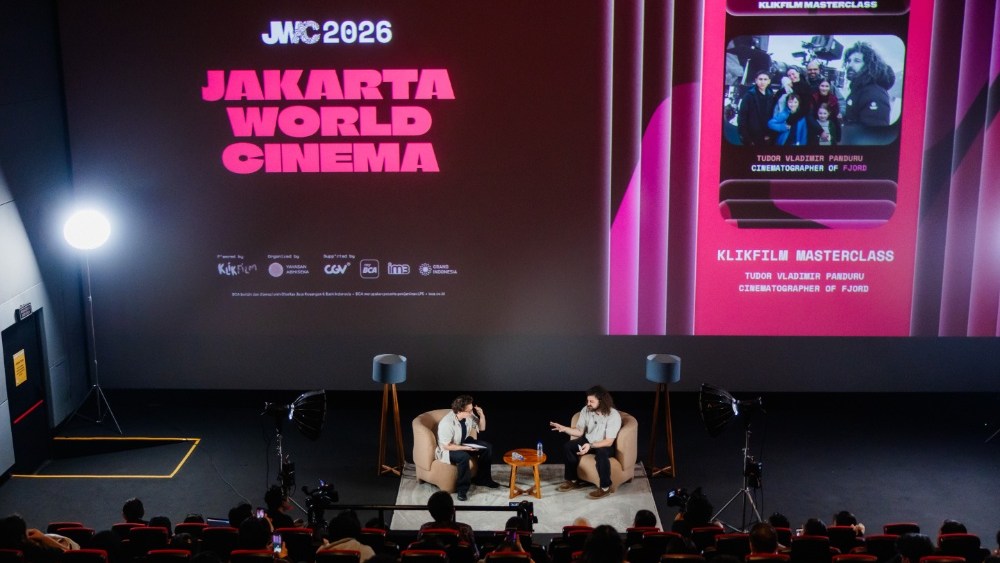
Romanian auteur Cristian Mungiu and his long-time collaborator, cinematographer Tudor Vladimir Panduru, shared their experiences in the productions of “Graduation”, “RMN”, “Fjord” and Iraqi director Hasan Hadi’s “President’s Cake” in the master class he gave at Jakarta World Cinema.
Benh Zeitlin, the Oscar-nominated director of “Beasts of the South,” said he moderated the session because “we hope to work together one day.” He praised Panduru as the kind of cinematographer who “can bring a dimension to your work beyond your personal imagination.”
The masterclass followed Panduru’s career chronologically, starting with a screening of an interior and an outdoor scene from “Graduation.” Panduru received training from Oleg Mutu, Mungiu’s long-time cinematographer, on films such as “4 Months, 3 Weeks and 2 Days” and met the Romanian director while he was still an intern. “Graduation” was Panduru’s second film as a cinematographer, but it was also the film that made his name known internationally.
Panduru said that the camera in Mungiu’s films should be unobtrusive and avoid pointing the viewer at certain things, because the audience is “smart enough to understand what’s going on there”.
“In Cristian Mungiu’s work, he usually shoots shot-by-shot, one scene per shot. There is no editing, no cutting. From a cinematographer’s point of view, things can be quite difficult because we end up doing a lot of takes and the performance is somehow the most important thing on the set,” said Panduru. “Sometimes we take 20, 30, 40 takes to get the best result.”
But the grueling repetition of long takes wasn’t as boring as one might think, because Mungiu is able to keep everyone fresh from start to finish. Panduru also pointed out that since shooting means living the moment with everyone on the set, the responsibility of staying fresh belongs to each individual.
“It’s also a matter of trust. When you start working in this kind of style, everyone puts a piece of themselves into the process, so there’s a moment of synchronicity,” he said. “We don’t do 30 takes because the footage is not good. [The one that works] All the elements need to come together for you to get the best outcome of everything.”
Zeitlin said Mungiu’s films value “openness and honesty” and criticize “hypocrisy and dishonesty”. Panduru agreed with this view and said that Romanian cinema is mostly based on social issues and that the issues touched upon by Mungiu are important. “I’m just trying to help him say it,” he said.
Panduru said that in choosing projects, artists should collaborate on the basis of common values and that he was lucky enough to choose the subjects that attracted him. He ruled out doing an action movie, “or maybe something with a social drama behind it. Everything is linked to intimacies.”
During the masterclass, several of Panduru’s defining scenes were shown, each followed by a technical analysis of how it was shot: “A 20-minute shot of more than 100 people gathered at the city hall in RMN,” a long shot next to a sailboat at sea in “The President’s Cake,” and two scenes from Mungiu’s last film, “Fjord.”
The use of light in “RMN” led to the discussion, with Panduru revealing that the daytime scene was actually shot at night. “You basically use focus pulling as a way to edit and reframe in the same shot without moving the camera at all,” he said of the hardest part of keeping 100+ people in focus in a single frame.
Zeitlin said that when he saw the “President’s Cake” clip, he realized that the same person shot the Mungiu movie. “I thought I should talk to the cinematographer,” he said, adding that the film’s aesthetic was markedly different from Mungiu’s.
Panduru said that the film is a children’s tale that naturally requires a different visual language. The natural landscape inspired him to render scenes more creatively and gave him the freedom to use movable jib arms and wheels; He continued to use these techniques again in “Fjord”.
The first clip from “Fjord,” which appears to have been shot during the “magic hour,” a family gathering and the brief window just before sunset, brought the controversy back to light. Panduru explained how he blocked out natural light from outside to give more time to performances.
The masterclass ended with another long shot from “Fjord,” in which the camera followed star Renate Reinsve from her search on the ground to her jump into the sea.
“It was really important to extend the emotional arc of the characters throughout the scene. [so] It was really important that Cristian did not interrupt at this moment,” Panduru said.
The cinematographer, who jumped into the freezing sea with Reinsve, said he thought it would be the simplest way to shoot it, but the hardest part was synchronizing the actor mid-jump. “And secondly, while I was doing this [it]”If I lose the camera at the jump -” he said as the audience laughed. “I had a really great grip team supporting me both in and out of the water.”